
When you pick up a modern blouse, a relaxed summer dress, or a pair of soft wide-leg pants, you may notice something different before you even check the label. The fabric feels smooth, cool, fluid, and slightly refined. It does not feel like basic cotton. It does not feel like ordinary polyester. It has a soft drape, a gentle sheen, and a natural comfort that works well for everyday clothing.
That fabric may be Tencel Lyocell fabric.
If you are sourcing fabric for shirts, dresses, pants, loungewear, pajamas, underwear, or modern womenswear, Tencel Lyocell is a material you will probably meet often. It is popular not only because it has a sustainability story, but also because it solves several practical clothing problems: comfort, drape, smooth touch, moisture management, and a premium appearance.
However, you should not choose it only because the name sounds good. You need to understand what Tencel Lyocell fabric is, how it is made, how it behaves after washing, whether it shrinks or wrinkles, how much it may cost, and whether it fits your final product.
This guide will help you understand Tencel Lyocell fabric from a buyer’s point of view.
What Is Tencel Lyocell Fabric?
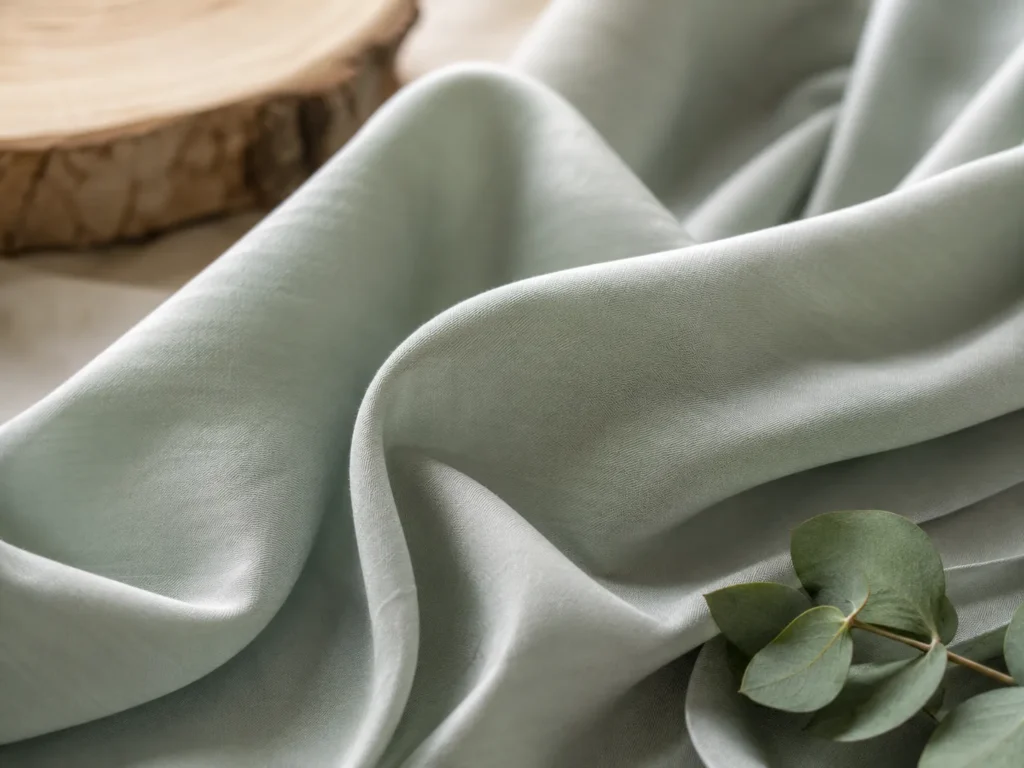
Tencel Lyocell fabric is a textile made with TENCEL™ Lyocell fibers, which are wood-based regenerated cellulosic fibers. These fibers are made from cellulose found in wood, then processed into fibers that can be spun into yarn and made into fabric.
The important point is this: Tencel Lyocell is not the same as raw natural fibers like cotton or linen, and it is not a petroleum-based synthetic fiber like polyester. It sits in the category of regenerated cellulosic fibers.
TENCEL™ is a branded fiber name owned by Lenzing. Lyocell is the generic fiber type. That means all TENCEL™ Lyocell is lyocell, but not all lyocell is officially TENCEL™ Lyocell. Lenzing describes TENCEL™ as its premium brand for textile applications, including TENCEL™ Lyocell and TENCEL™ Modal fiber solutions.
For fabric sourcing, this distinction matters. If your customer asks for TENCEL™ Lyocell, you should not simply buy any fabric labeled “lyocell.” You need to confirm whether the fiber is officially branded and whether your supplier can provide documentation.
What Is Tencel Lyocell Fabric Made Of?
Tencel Lyocell fabric is made from wood-based cellulose. The wood is turned into pulp, then dissolved and regenerated into fibers. These fibers can then be spun into yarn and made into different fabric structures.
You may see Tencel Lyocell used in:
- Woven fabric
- Knit fabric
- Twill fabric
- Denim fabric
- Jersey fabric
- Blended fabric
The final fabric can be 100% Tencel Lyocell, or it can be blended with cotton, linen, wool, polyester, spandex, or other fibers to improve price, strength, elasticity, wrinkle resistance, or texture.
So when you ask a supplier for “Tencel fabric,” you should always ask one more question:
What exactly is the composition and fabric construction?
How Is Lyocell Fabric Made?
To understand why Tencel Lyocell is popular, you need to understand how lyocell is produced.
Step 1: From Wood to Pulp
Lyocell begins with wood-based cellulose. The wood is processed into pulp, which becomes the base material for fiber production.
For sustainability claims, the wood source matters. TENCEL™ Lyocell fibers use wood sourced from certified or controlled wood sources, according to Lenzing’s product information.
If you are buying fabric for an eco-conscious brand, you should ask whether the supplier can provide fiber origin details, certification information, or related documents.
Step 2: Dissolving the Cellulose
The cellulose pulp is dissolved into a spinning solution. This is what makes lyocell different from raw natural fibers. Cotton and linen are directly spun from natural fibers, but lyocell is made through a regenerated fiber process.
This does not make it “bad.” It simply means you should describe it accurately as a wood-based regenerated cellulosic fiber.
Step 3: Spinning the Fiber
The dissolved cellulose solution is pushed through spinnerets to form filaments. These filaments are then washed, dried, and processed into fibers.
After that, the fiber can be spun into yarn and made into woven, knit, denim, twill, jersey, or blended fabrics.
Step 4: Closed-Loop Production Process
One of the strongest selling points of TENCEL™ Lyocell is its closed-loop production process. Lenzing states that more than 99.8% of the solvent used in TENCEL™ Lyocell fiber production is recovered and fed back into the production loop.
This is why Tencel Lyocell is often used by brands that want a lower-impact material story.
However, you should avoid saying it has “zero impact.” A more accurate expression is:
Tencel Lyocell can offer a lower-impact production story when sourced and processed responsibly.
Step 5: From Fiber to Fabric
Once the fiber is made, the final fabric still depends on yarn, weave, knitting structure, dyeing, finishing, and blending.
This is where many buyers make mistakes. They think all Tencel Lyocell fabrics feel and perform the same.
They do not.
A lightweight woven Tencel Lyocell shirt fabric behaves differently from Tencel Lyocell jersey. A Tencel twill for pants behaves differently from Tencel denim. A 100% Lyocell fabric behaves differently from a Tencel cotton or Tencel linen blend.
That is why you need to choose fabric based on your final product, not just the fiber name.
Where Is Lyocell Fabric Produced?
Lyocell fiber production and lyocell fabric production are not always in the same place.
The fiber may come from a major fiber producer, while the fabric may be woven, knitted, dyed, printed, or finished in another country. Lenzing, for example, is an international company with multiple production sites and sales offices.
In 2022, Lenzing opened a large lyocell plant in Thailand with a nameplate capacity of 100,000 tons per year to serve demand for TENCEL™ branded lyocell fibers.
For fabric buyers, common textile supply regions for Tencel Lyocell fabrics may include China, Turkey, India, Vietnam, South Korea, Taiwan, and parts of Europe. These regions may handle weaving, knitting, dyeing, printing, finishing, and garment production.
The production location can affect:
- MOQ
- Lead time
- Price
- Color development
- Finishing options
- Certification documents
- Bulk consistency
- Customization ability
If you are sourcing for a fashion brand, you should not only ask where the fabric is located. You should also ask where the fiber comes from, where the fabric is processed, and whether the supplier can support your documentation needs.
Why Is Tencel Lyocell Popular in Modern Clothing?
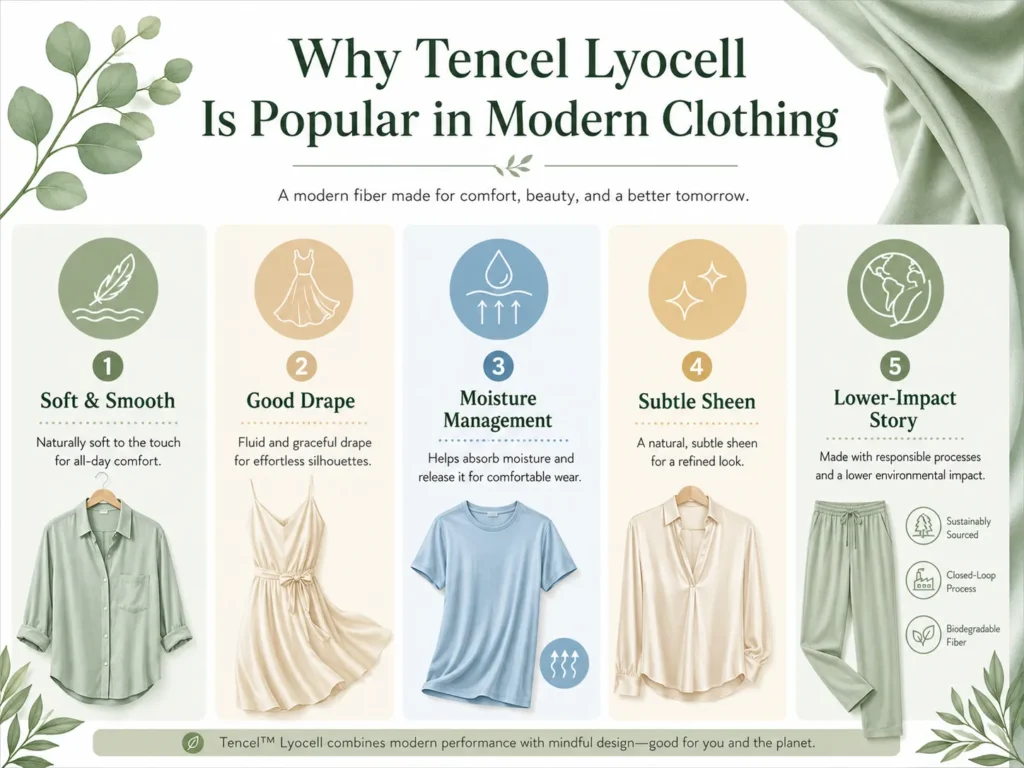
Tencel Lyocell is popular because it matches what many modern clothing brands want: soft touch, clean appearance, better drape, comfort, and a more responsible material story.
1. Soft and Smooth Hand Feel
If your product touches the skin directly, hand feel matters.
Tencel Lyocell fabrics often feel smooth and comfortable. Lenzing describes TENCEL™ Lyocell fibers as naturally soft and smooth, making fabrics pleasant against the skin.
This makes it useful for:
- Shirts
- Blouses
- Dresses
- Pajamas
- Loungewear
- Underwear
- Base layers
- Soft tops
For many customers, the first touch creates the first impression of quality.
2. Comfortable Moisture Management
Tencel Lyocell is often chosen for comfort because it supports moisture regulation. This can help the wearer feel more comfortable in daily wear, especially in warm-weather clothing, travel clothing, and skin-contact garments.
That said, you should not judge comfort by fiber alone. A breathable Tencel woven shirt and a heavy Tencel blend trouser fabric will not feel the same. Fabric weight, density, yarn, finishing, and garment design all matter.
3. Good Drape for Modern Silhouettes
Tencel Lyocell is especially useful when you want a garment to fall naturally.
It works well for modern clothing shapes such as:
- Relaxed shirts
- Fluid dresses
- Wide-leg pants
- Soft skirts
- Loose blouses
- Minimalist womenswear
- Resort wear
If your design needs movement and flow, Tencel Lyocell can give a more elegant drape than many basic cotton fabrics.
4. Subtle Sheen and Premium Appearance
Many Tencel Lyocell fabrics have a subtle sheen. It is not as shiny as satin, but it can look more refined than basic matte cotton.
This makes it attractive for:
- Premium basics
- Modern womenswear
- Minimalist fashion
- Workwear-inspired casual clothing
- Capsule wardrobe products
If you want a simple garment to look more elevated, Tencel Lyocell can help.
5. Lower-Impact Brand Story
Modern consumers pay more attention to what fabrics are made from and how they are produced. Tencel Lyocell gives brands a stronger material story because it is wood-based and uses a closed-loop production process.
Lenzing also states that TENCEL™ Lyocell fibers are made with at least 50% less carbon emissions and water consumption compared to generic lyocell, according to its product claims.
For a clothing brand, this can support a more responsible product positioning. But you still need to verify claims with supplier documents.
Key Characteristics of Tencel Lyocell Fabric
Softness
Tencel Lyocell is known for softness and smooth touch. This makes it useful for garments worn close to the body.
If you are developing pajamas, inner tops, loungewear, or soft shirts, this is one of its strongest advantages.
Drape
Tencel Lyocell usually has good drape, especially in woven fabrics. It can create soft movement and a fluid shape.
This is why you often see it in dresses, skirts, blouses, and wide-leg pants.
Breathability and Moisture Control
Tencel Lyocell can be comfortable in warm conditions, but breathability depends on construction. A lightweight woven fabric will usually feel different from a dense twill or heavy knit.
Before buying in bulk, test the fabric in the actual product category.
Subtle Shine
Tencel Lyocell often has a refined surface appearance. It can make simple designs look more premium without needing heavy finishing.
Color Performance
Tencel Lyocell can be dyed into rich colors, but you still need to confirm lab dips, color fastness, and bulk shade consistency.
For e-commerce brands, color difference between batches can create return problems, so you should control this early.
Potential Wrinkling
Tencel Lyocell can wrinkle, especially in lightweight woven fabrics.
If your customer wants wrinkle resistance, you should consider:
- Higher fabric weight
- Twill construction
- Blended fabric
- Anti-wrinkle finishing
- Garment design adjustments
Do not assume smooth hand feel means wrinkle-free performance.
What Different Types of Lyocell Fabric Are There?
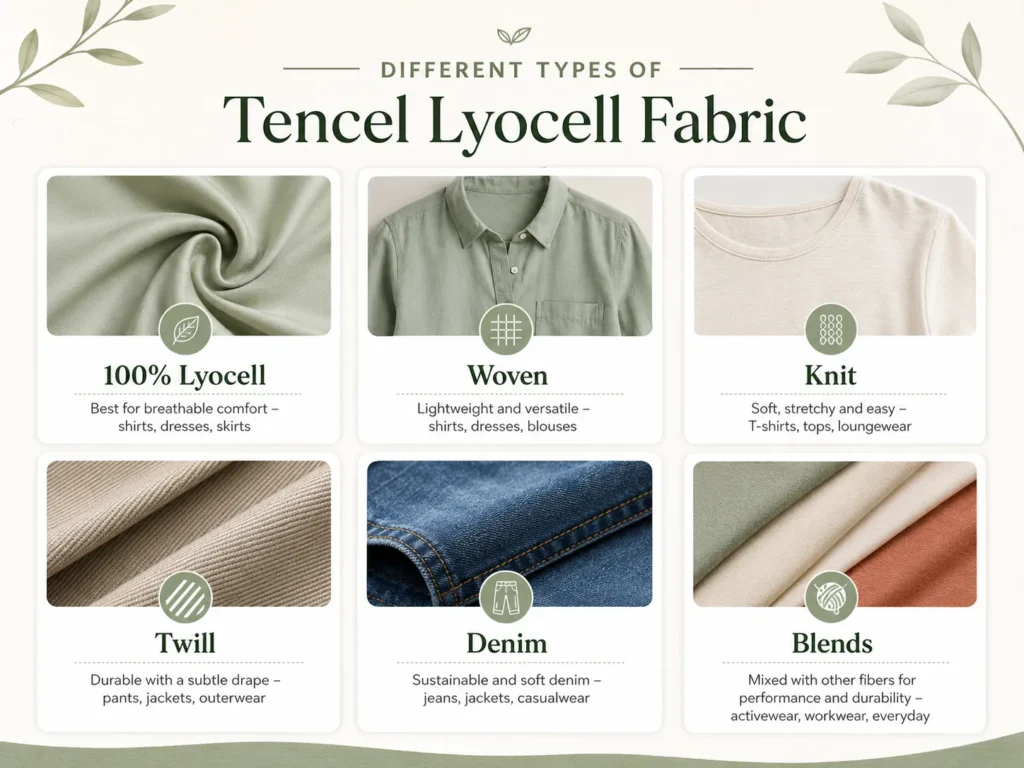
Tencel Lyocell can be made into many fabric types. You should choose based on the final garment.
100% Tencel Lyocell Fabric
100% Tencel Lyocell fabric gives you the clearest Lyocell hand feel: smooth, soft, fluid, and refined.
It is suitable for mid-to-premium clothing, but it may cost more than blended options. You also need to check shrinkage, wrinkling, and garment care performance.
Tencel Lyocell Woven Fabric
Woven Tencel Lyocell fabric is commonly used for:
- Shirts
- Blouses
- Dresses
- Skirts
- Wide-leg pants
- Lightweight jackets
It usually has good drape and a clean surface. If you are developing modern womenswear, this is one of the most useful categories.
Tencel Lyocell Knit Fabric
Knit Tencel Lyocell fabric is suitable for:
- T-shirts
- Loungewear
- Underwear
- Pajamas
- Base layers
- Soft tops
The stretch depends on knitting structure and whether spandex is added. If you need strong recovery, ask for stretch and recovery test data.
Tencel Lyocell Twill
Tencel Lyocell twill gives more structure and texture than plain woven fabric.
It is suitable for:
- Pants
- Casual trousers
- Structured shirts
- Lightweight jackets
- Workwear-inspired fashion
If you want both drape and structure, twill can be a good option.
Tencel Lyocell Denim
Tencel Lyocell denim is softer and more fluid than traditional heavy denim.
It can be used for:
- Soft denim shirts
- Lightweight jeans
- Denim dresses
- Casual jackets
- Relaxed skirts
It is useful when you want denim styling with improved comfort.
Tencel Lyocell Blended Fabric
Tencel Lyocell is often blended with other fibers to adjust performance.
Common blends include:
- Tencel cotton
- Tencel linen
- Tencel wool
- Tencel polyester
- Tencel spandex
Blending can help improve cost, wrinkle resistance, elasticity, texture, durability, and structure.
For example, Tencel linen fabric can give you linen texture with a smoother touch. Tencel spandex fabric can provide more stretch. Tencel polyester blends may improve durability and cost control.
How Is Lyocell Fabric Used?
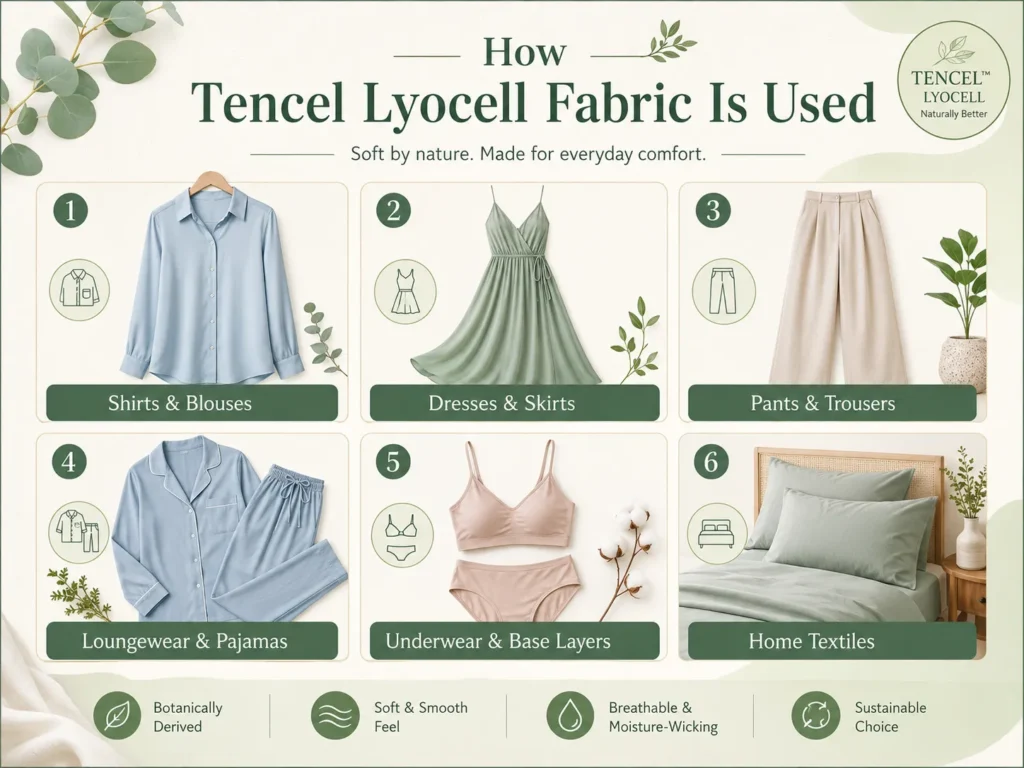
Tencel Lyocell is used in many modern clothing and home textile products.
Shirts and Blouses
Tencel Lyocell works well for shirts and blouses because it gives a softer appearance than traditional crisp cotton shirting.
It is useful when you want a shirt to look relaxed, premium, and easy to wear.
Dresses and Skirts
If you need movement and drape, Tencel Lyocell can be a strong choice for dresses and skirts.
It is especially suitable for summer dresses, resort dresses, work dresses, and minimalist womenswear.
Pants and Trousers
For pants, you should choose the construction carefully.
Tencel Lyocell twill or blended fabric is usually more suitable than very lightweight plain weave. Pants need better abrasion resistance, shape retention, and shrinkage control.
Loungewear and Pajamas
Tencel Lyocell knit or soft woven fabric can work well for pajamas and loungewear.
The key checks are hand feel after washing, shrinkage, pilling, and color fastness.
Activewear and Athleisure
Tencel Lyocell can be used in light athleisure, yoga-inspired clothing, and casual activewear.
For high-performance sportswear, you may need spandex, polyester, nylon, or technical finishing to improve stretch, recovery, and quick-dry performance.
Underwear and Base Layers
Tencel Lyocell and TENCEL™ Modal are both commonly considered for skin-contact products.
For underwear and base layers, you should check softness, stretch recovery, seam behavior, wash stability, and safety certifications.
Home Textiles
Tencel Lyocell is also used in bed sheets, pillowcases, duvet covers, and other home textiles.
The selling points are usually smooth touch, moisture management, and sleeping comfort.
Who Is Lyocell Particularly Suitable For?
Tencel Lyocell is not only suitable for one type of brand. It can work for different product directions.
For Modern Womenswear Brands
If your brand focuses on relaxed shirts, soft dresses, skirts, and fluid silhouettes, Tencel Lyocell can help you create a modern and premium feel.
For Comfort-Focused Clothing Brands
If your products are designed around skin feel, softness, and daily comfort, Tencel Lyocell can be useful in loungewear, pajamas, underwear, and base layers.
For Sustainable or Eco-Conscious Brands
If your brand needs a lower-impact material story, Tencel Lyocell can be a strong option. But you should support any sustainability claim with documents, certifications, and accurate wording.
For Travel and Everyday Apparel
Tencel Lyocell is comfortable and refined, which makes it useful for travel shirts, lightweight pants, and everyday garments.
However, if wrinkle resistance is a top priority, you should test fabric construction and finishing carefully.
How Much Does Lyocell Fabric Cost?
Lyocell fabric cost depends on more than the fiber name.
The price can vary based on:
- Whether it is genuine TENCEL™ Lyocell
- Fiber composition
- Blending ratio
- Fabric construction
- GSM / fabric weight
- Dyeing process
- Finishing process
- Certification requirements
- MOQ
- Order quantity
- Custom color needs
- Stock availability
- Bulk lead time
100% Tencel Lyocell vs Blended Lyocell Cost
100% Tencel Lyocell fabric is usually more expensive than many basic polyester, basic cotton, or low-cost viscose fabrics.
Blended fabrics can help balance price and performance. For example, a Tencel cotton blend may reduce cost while keeping softness. A Tencel linen blend can add texture. A Tencel polyester blend may improve durability or price competitiveness.
Why You Should Not Compare Price Only
Low price may mean:
- Generic lyocell instead of TENCEL™ Lyocell
- Lower Lyocell content
- Unstable bulk quality
- Poor color fastness
- Higher shrinkage
- Weak finishing
- No documentation support
For B2B sourcing, the better question is not simply “How much per meter?” It is:
Can this fabric meet my quality, performance, documentation, and production requirements?
Tencel Lyocell vs Other Fabrics
Tencel Lyocell vs Cotton
Cotton is familiar, natural, breathable, and widely used. It has a more traditional hand feel.
Tencel Lyocell is usually smoother and has better drape. It is often better for fluid silhouettes, soft womenswear, and premium casual clothing.
You can also blend the two to balance natural cotton touch with Lyocell smoothness.
Tencel Lyocell vs Viscose / Rayon
Lyocell and viscose are both regenerated cellulosic fibers, but their production processes differ.
TENCEL™ Lyocell is especially known for its closed-loop production process. Viscose is often lower cost, but Lyocell is usually chosen when brands want better sustainability positioning and a more premium fabric story.
Tencel Lyocell vs Polyester
Polyester is durable, easy-care, and widely used in functional and low-to-mid-cost clothing.
Tencel Lyocell feels more natural, smoother, and more fluid. It is more suitable when comfort, drape, and skin feel are important.
Blends can help combine the strengths of both.
Tencel Lyocell vs Linen
Linen is crisp, dry, textured, and naturally breathable. It has a stronger natural look.
Tencel Lyocell is smoother, softer, and more flowing.
A Tencel linen blend can be useful when you want linen texture but do not want the fabric to feel too rough or stiff.
TENCEL Lyocell vs Modal: What’s the Difference?
TENCEL™ Lyocell and TENCEL™ Modal are both branded cellulosic fibers from Lenzing, but they are often used for different product goals.
What Is TENCEL Modal Fabric?
TENCEL™ Modal fabric is made with TENCEL™ Modal fibers. Modal is also a wood-based regenerated cellulosic fiber. It is known for softness, smooth touch, and comfort in skin-contact garments.
Lenzing describes TENCEL™ Modal fibers as supporting high moisture regulation and long-lasting softness.
Is TENCEL Modal a Natural Fibre?
TENCEL™ Modal comes from wood-based cellulose, but it is processed through a regenerated fiber method. So it is more accurate to describe it as a wood-based regenerated cellulosic fiber, not as a raw natural fiber like cotton or linen.
TENCEL Lyocell vs Modal
You can understand the difference this way:
TENCEL™ Lyocell is often used when you need smooth touch, drape, moisture management, and stronger fabric applications such as shirts, dresses, pants, and home textiles.
TENCEL™ Modal is often used when you need long-lasting softness and skin-contact comfort, such as underwear, pajamas, loungewear, T-shirts, and base layers.
If your product needs a fluid woven look, Tencel Lyocell may be better. If your product needs ultra-soft comfort against the skin, Modal may be more suitable.
Benefits of TENCEL and Modal Fabrics
Both TENCEL™ Lyocell and TENCEL™ Modal can help you create fabrics with:
- Soft touch
- Comfortable wear
- Moisture management
- Skin-contact comfort
- Better material story
- Premium hand feel
Your choice depends on the final product.
Advantages and Disadvantages of Lyocell Products
Advantages of Tencel Lyocell Fabric
Tencel Lyocell can offer several practical advantages:
- Smooth and soft hand feel
- Good drape
- Comfortable moisture management
- Skin-friendly comfort
- Premium appearance
- Lower-impact production story
- Versatility in woven and knit fabrics
- Good blending potential
This makes it suitable for many modern clothing categories.
Disadvantages of Tencel Lyocell Fabric
Tencel Lyocell also has limitations:
- It can wrinkle, especially in lightweight woven fabrics
- It may shrink if not properly processed
- It can cost more than basic fabrics
- It may not be structured enough for some tailored products
- It may need documentation if you use TENCEL™ branding
- It requires fabric testing before bulk production
A good fabric is not a perfect fabric. It is a fabric that fits the product requirement.
How Does Lyocell Fabric Impact the Environment?
Lyocell is often promoted as a more responsible material, but you should understand the details before making claims.
Is Lyocell Really Sustainable?
Lyocell can be a lower-impact option, especially when made from responsibly sourced wood and produced with solvent recovery systems.
But the final environmental impact also depends on:
- Wood source
- Fiber production
- Dyeing
- Finishing
- Blending
- Transportation
- Product lifespan
- Garment care
- End-of-life treatment
You should avoid broad claims like “100% sustainable” unless you have evidence.
Sustainable Forestry and Wood Used
Wood sourcing is important. TENCEL™ Lyocell uses certified or controlled wood sources according to Lenzing’s product information.
If your brand needs sustainability claims, ask your supplier for FSC, PEFC, or related documentation where relevant.
Closed-Loop Solvent Recovery
The closed-loop production process is one of the most important environmental advantages of TENCEL™ Lyocell. More than 99.8% of the solvent is recovered and reused in the process.
This helps reduce waste compared with less efficient production methods.
Is Tencel Lyocell Fabric Toxic?
Tencel Lyocell fabric is generally considered safe for clothing use, but safety depends on more than the fiber.
You should also check:
- Dyes
- Finishing agents
- Coatings
- Printing chemicals
- Skin-contact standards
- OEKO-TEX or similar testing
If you are making underwear, babywear, sleepwear, or skin-contact clothing, safety documents are important.
Biodegradability and End of Life
Lenzing states that LENZING™ Lyocell, Modal, and Viscose standard fibers are certified by TÜV AUSTRIA as biodegradable in soil, freshwater, and marine environments, and compostable under home and industrial conditions.
But you should be careful with finished fabric claims. If the fabric is blended with polyester or spandex, or treated with coatings or complex finishes, the finished textile may not have the same biodegradability profile as the pure fiber.
Always separate fiber-level claims from finished-fabric claims.
How to Choose the Right Tencel Lyocell Fabric
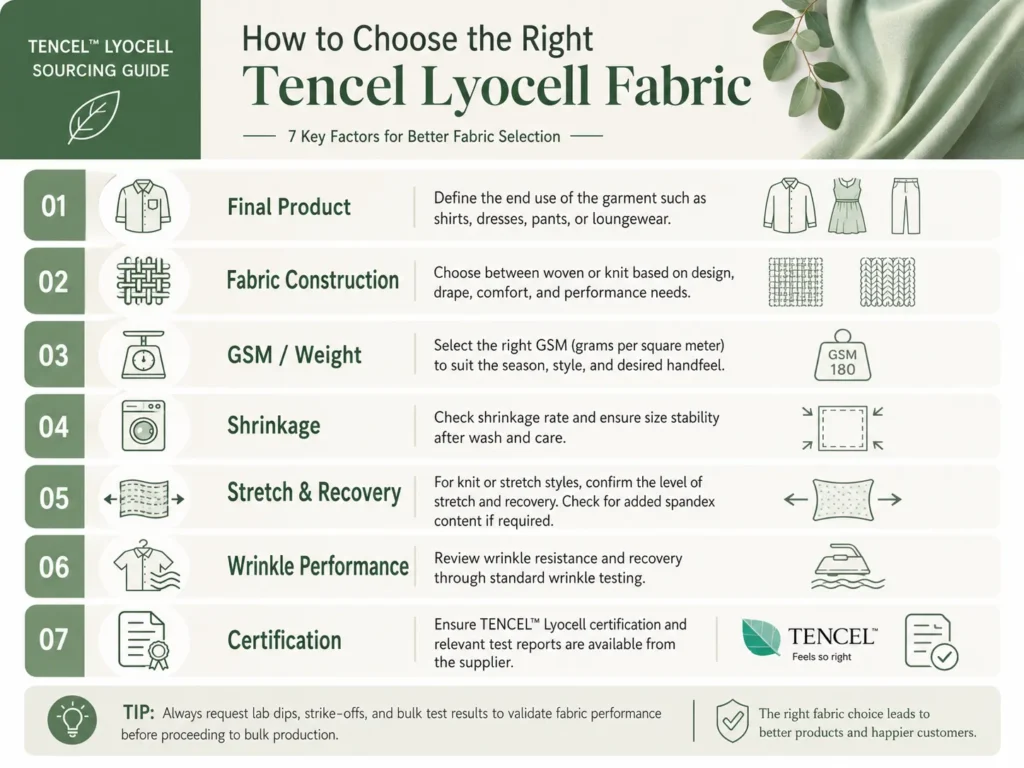
Choosing the right Tencel Lyocell fabric starts with the final product.
Start with the Final Product
Before you ask for fabric samples, ask yourself:
- Are you making shirts, dresses, pants, pajamas, underwear, or bedding?
- Does the garment need drape or structure?
- Does it need stretch?
- Will it touch the skin directly?
- Does it need to resist wrinkles?
- What is the target price?
- Will you promote sustainability claims?
- Does your customer require TENCEL™ documentation?
Your product answers should guide the fabric selection.
Choose the Right Fabric Construction
Choose woven Tencel Lyocell for shirts, blouses, dresses, skirts, and pants.
Choose knit Tencel Lyocell for T-shirts, pajamas, underwear, and loungewear.
Choose Tencel twill for trousers, structured shirts, and lightweight jackets.
Choose Tencel denim for casualwear and soft denim products.
Choose blended Tencel fabrics when you need better cost control, stretch, texture, or wrinkle resistance.
Check GSM and Fabric Weight
Lightweight fabrics work well for summer shirts, dresses, and blouses. Medium-weight fabrics are better for pants, skirts, and structured garments.
If the fabric is too light, it may be transparent, unstable, or easy to wrinkle. If it is too heavy, it may lose the soft drape that makes Tencel Lyocell attractive.
Check Shrinkage and Dimensional Stability
Shrinkage is one of the most important tests.
Before bulk production, ask for shrinkage data after washing. If you are making e-commerce apparel, size stability is critical because returns can become expensive.
Check Stretch and Recovery
Tencel Lyocell itself is not a high-stretch fiber. Stretch depends on fabric construction and whether spandex or elastane is added.
If your garment needs body movement, ask:
- Does the fabric stretch?
- In which direction?
- What is the stretch percentage?
- What is the recovery rate?
- Does it bag out after wear?
Check Wrinkle Performance
If you are developing travel clothing, officewear, or daily essentials, wrinkle performance matters.
Lightweight woven Tencel Lyocell may wrinkle. Blends, twill construction, and finishing can improve this.
Check Certification and Branding Requirements
If you want to use the word TENCEL™ in your product page, hangtag, packaging, or marketing material, confirm that your supplier can provide the correct documentation.
Do not market ordinary lyocell as TENCEL™ unless the fiber source supports that claim.
How to Care for TENCEL Lyocell Fabrics
Care depends on the exact fabric construction and garment design, but the following rules are useful.
Washing
Use gentle washing. Avoid harsh cycles, high temperature, and strong detergents unless the care label allows them.
Dark colors should be washed separately.
Drying
Avoid high heat drying. High heat may affect shrinkage, hand feel, and garment shape.
Air drying or low-temperature drying is usually safer.
Ironing
You can iron Tencel Lyocell and Modal fabrics, but use low to medium heat.
For lightweight woven Tencel, steam can help reduce wrinkles. Always follow the garment care label.
Storage
Hang woven shirts, dresses, and trousers if you want to reduce wrinkles.
Fold knit Tencel or Modal garments to prevent stretching and hanger marks.
Common Mistakes When Buying Tencel Lyocell Fabric
Mistake 1: Treating All Lyocell as TENCEL™
Lyocell is a generic fiber type. TENCEL™ is a brand.
If your customer specifically asks for TENCEL™, confirm documentation before purchasing.
Mistake 2: Only Checking Hand Feel
A fabric can feel excellent in your hand but still shrink, wrinkle, fade, or lose shape after washing.
Always check test data and sample performance.
Mistake 3: Ignoring Fabric Construction
Woven, knit, twill, denim, and jersey are not the same.
Do not choose fabric based only on fiber name.
Mistake 4: Choosing the Wrong Weight
A lightweight Tencel woven may work well for a blouse but fail as pants.
A heavier twill may work for pants but feel too heavy for summer dresses.
Match GSM to product use.
Mistake 5: Making Sustainability Claims Without Proof
Do not claim sustainability only because the fabric contains Lyocell.
Check fiber source, certification, blend ratio, dyeing, finishing, and finished fabric documentation.
Conclusion: Is Tencel Lyocell Fabric Right for Your Clothing Project?
Tencel Lyocell fabric is popular in modern clothing because it gives you a rare combination of smooth touch, soft drape, moisture management, premium appearance, and a lower-impact material story.
It can work well for shirts, blouses, dresses, pants, loungewear, pajamas, underwear, and home textiles. But it is not a universal fabric for every product. If you need heavy structure, extreme stretch, low-cost production, or strong wrinkle resistance, you need to choose the right construction, blend, weight, and finishing.
Before you order Tencel Lyocell fabric, do not only ask whether the supplier has “Tencel fabric.” Ask what type it is, whether it is genuine TENCEL™ Lyocell, what the composition is, how it performs after washing, whether it shrinks or wrinkles, and whether it fits your final garment.
The best Tencel Lyocell fabric is not only soft and sustainable in concept. It must also be stable, practical, and suitable for real garment production.
FAQ About Tencel Lyocell Fabric
Does Tencel Lyocell fabric shrink?
Yes, it can shrink if the fabric is not properly processed or pre-shrunk. You should always check shrinkage test results before bulk production.
Does Tencel Lyocell fabric stretch?
Tencel Lyocell fiber itself is not highly elastic. Stretch depends on the fabric construction and whether spandex or elastane is added.
Does Tencel Lyocell wrinkle?
Yes, it can wrinkle, especially in lightweight woven fabrics. Blending, finishing, and fabric weight can help improve wrinkle performance.
Is Tencel Lyocell a good fabric?
Yes, it is a good fabric for clothing that needs softness, smooth touch, drape, moisture management, and a premium feel. But it may not be ideal for very low-cost or highly structured garments.
Is Tencel Lyocell fabric toxic?
Tencel Lyocell fabric is generally suitable for clothing, but final safety depends on dyes, finishing, coatings, and testing standards. For skin-contact products, ask for safety certifications.
How breathable is Lyocell?
Lyocell can be breathable and comfortable, but breathability depends on fabric construction, density, weight, and finishing.
Is Lyocell a microfiber?
No. Lyocell is a regenerated cellulosic fiber. Microfiber usually refers to very fine synthetic fibers, often polyester or nylon.
Is Tencel Lyocell good for summer clothing?
Yes, it can be good for summer clothing when the fabric is lightweight, breathable, and suitable for warm-weather garments.
Is Tencel Lyocell better than cotton?
It depends on the product. Tencel Lyocell is usually smoother and has better drape. Cotton has a more familiar natural hand feel. Many brands blend both.
Can Tencel Lyocell be blended with other fibers?
Yes. It can be blended with cotton, linen, wool, polyester, spandex, and other fibers to adjust cost, texture, stretch, wrinkle resistance, and durability.
What is the best way to wash and care for Lyocell?
Use gentle washing, avoid high heat, separate dark colors, and follow the garment care label. Low-temperature ironing or steaming can help reduce wrinkles.