
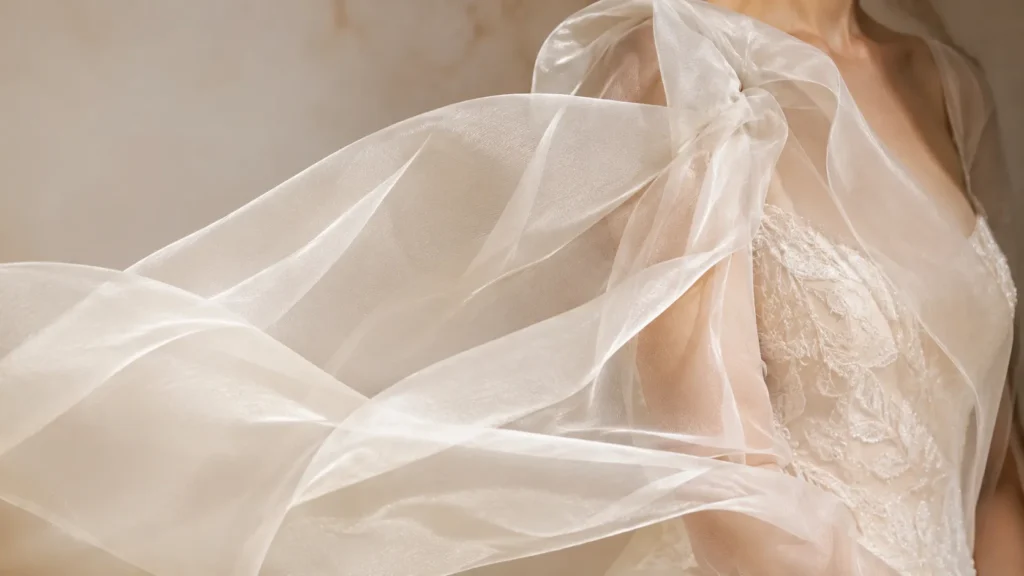
When you see a wedding dress with a light, airy skirt that gently holds its shape under the light, you may be looking at organza fabric. It does not fall as softly as chiffon. It does not shine as heavily as satin. It does not look like open netting the way tulle does. Organza sits somewhere in between: sheer, lightweight, crisp, elegant, and structured.
If you are sourcing fabric for bridalwear, evening dresses, fashion garments, decoration, packaging, or stage costumes, you need to understand what organza fabric is before you choose it. The name “organza” alone is not enough. You need to know its fiber content, stiffness, transparency, finishing, production quality, and whether it is suitable for your final product.
This guide explains what organza fabric is, how it is made, where it is produced, what types are available, how it impacts the environment, and what you should check before buying it in bulk.
What is Organza Fabric?
Organza fabric is a lightweight, sheer, crisp woven fabric. It is usually made with a plain weave structure and fine filament yarns, which gives it a transparent appearance and a slightly stiff hand feel.
Traditionally, organza was made from silk. Today, many commercial organza fabrics are made from polyester, nylon, or blended fibers. Merriam-Webster defines organza as a sheer dress fabric, often made of silk or nylon, and resembling organdy.
You can think of organza as a fabric that gives you three main effects:
- Transparency
- Lightness
- Structure
That is why you often see it in bridal gowns, evening dresses, sleeves, overlays, ruffles, decorations, gift bags, and luxury packaging.
A Brief History of Organza Fabric
Organza has a long connection with silk fabric and historic trade routes. The word “organza” is commonly linked to French “organsin” and Italian “organzino,” both associated with fine silk thread. Etymonline traces the English word “organza” to the early 19th century and connects it with French and Italian silk-related terms.
Another common explanation connects the word to Urgench, a city along the Silk Road. This history matters because early organza was closely connected with silk weaving and luxury textiles. Over time, as polyester and nylon became widely used in modern textile production, organza became more accessible for commercial fashion, decoration, packaging, and costume industries.
So when you buy organza today, you are not always buying silk organza. You may be buying polyester organza, nylon organza, or a blended organza designed for cost control, color variety, or bulk production.
Is Organza a Woven Fabric?
Yes, organza is a woven fabric.
It is usually made with a plain weave structure, where warp and weft yarns cross over and under each other in a simple pattern. This is different from knit fabric, which is made from interlocking loops.
Because organza is woven, it usually has little to no natural stretch. Its value is not elasticity. Its value is transparency, crispness, light structure, and visual volume.
If your garment needs strong stretch and body movement, organza is usually not the main fabric you should choose. But if your product needs a sheer overlay, structured sleeve, voluminous skirt, or decorative layer, organza can be very effective.
What is Organza Fabric Made Of?
Organza can be made from different fibers. The fiber content will affect price, hand feel, shine, care requirements, durability, and environmental impact.
Silk Organza
Silk organza is the traditional and more premium version of organza. It has a natural shine, refined texture, and elegant appearance. You may choose silk organza for luxury bridalwear, couture gowns, premium evening dresses, and high-end fashion designs.
However, silk organza is usually more expensive and requires more careful handling. It may also need professional cleaning or more delicate garment care.
If you are sourcing silk organza, you should check:
- Silk content
- Fabric weight
- Transparency
- Stiffness
- Color consistency
- Dyeing quality
- Width
- MOQ
- Care requirements
Silk organza is suitable when your product positioning is premium and your customer expects a luxury hand feel and natural fiber story.
Polyester Organza
Polyester organza is one of the most common types in today’s commercial market. It is more cost-effective than silk organza, easier to source in large quantities, and available in many colors and finishes.
You may choose polyester organza for:
- Commercial bridalwear
- Bridesmaid dresses
- Stage costumes
- Event dresses
- Party decoration
- Gift bags
- Floral packaging
- Craft projects
Polyester organza is especially useful when you need color variety, lower cost, and bulk production stability. But you still need to check hand feel, stiffness, color fastness, fabric width, and batch consistency.
Nylon Organza
Nylon organza is another synthetic option. It can be lightweight and slightly different in hand feel from polyester organza. You may see nylon organza in decoration, packaging, accessories, trims, or special fashion designs.
Before choosing nylon organza, you should confirm its strength, transparency, color effect, and whether it fits your intended product.
Blended Organza
Some organza fabrics are made with blended yarns. A supplier may blend fibers to adjust cost, shine, durability, softness, or stiffness.
For B2B fabric sourcing, do not rely only on the word “organza.” Always ask for fiber composition. Two organza fabrics may look similar in photos but behave very differently in sewing, washing, packaging, and final product use.
How is Organza Fabric Made?
Organza is usually made through weaving, using fine yarns and a plain weave structure. The final effect depends on yarn type, yarn fineness, weave density, and finishing.
Plain Weave Structure
Most organza fabrics use a plain weave. In this structure, the warp and weft yarns cross over and under each other in a simple and stable pattern.
This gives organza a clean surface, light structure, and transparent effect. The fabric is not heavy, but it can still hold shape better than many soft sheer fabrics.
Fine Yarn and Sheer Construction
Organza is usually made with fine yarns. These fine yarns allow light to pass through the fabric, creating the sheer look.
The openness of the weave and the fineness of the yarn both affect transparency. If the yarn is too coarse or the density is too high, the fabric may look less transparent. If the structure is too loose, it may lose stability.This is why you should always check a physical sample before ordering organza fabric in bulk.
Finishing Process
Finishing is very important for organza. It can change the stiffness, shine, hand feel, surface texture, and stability.
Some organza is finished to be crisp and structured for bridal skirts or decorative forms. Some is lighter and softer for sleeves, overlays, or fashion garments. Some may be crushed, printed, embroidered, or given a shiny finish.
If you are buying organza for a commercial product, you should not judge it only by pictures. You need to touch it, fold it, layer it, test it under light, and see how it behaves in the final design.
Where Is Organza Fabric Produced?
Organza fabric is produced in different countries and regions, depending on fiber type, quality level, and target market.
Silk organza is traditionally linked to regions with strong silk weaving history. Synthetic organza, such as polyester and nylon organza, is more commonly produced in areas with developed textile manufacturing and synthetic fiber supply chains.
Common production regions include:
- China
- India
- Italy
- France
- South Korea
- Taiwan
- Southeast Asia
China is one of the major producers of silk organza, polyester organza, nylon organza, printed organza, embroidered organza, and commercial organza fabrics. Wikipedia notes that silk organza is woven by mills along the Yangtze River and in Zhejiang, China; coarser silk organza is woven around Bangalore, India; and deluxe silk organzas are woven in France and Italy.
For B2B buyers, the production region can affect:
- Price
- MOQ
- Lead time
- Color options
- Customization ability
- Finishing quality
- Embroidery or printing capability
- Bulk consistency
If you need large-scale commercial production, you may focus on suppliers with strong color, finishing, and production capacity. If you need luxury couture quality, you may prioritize premium silk organza sources.
Key Characteristics of Organza Fabric
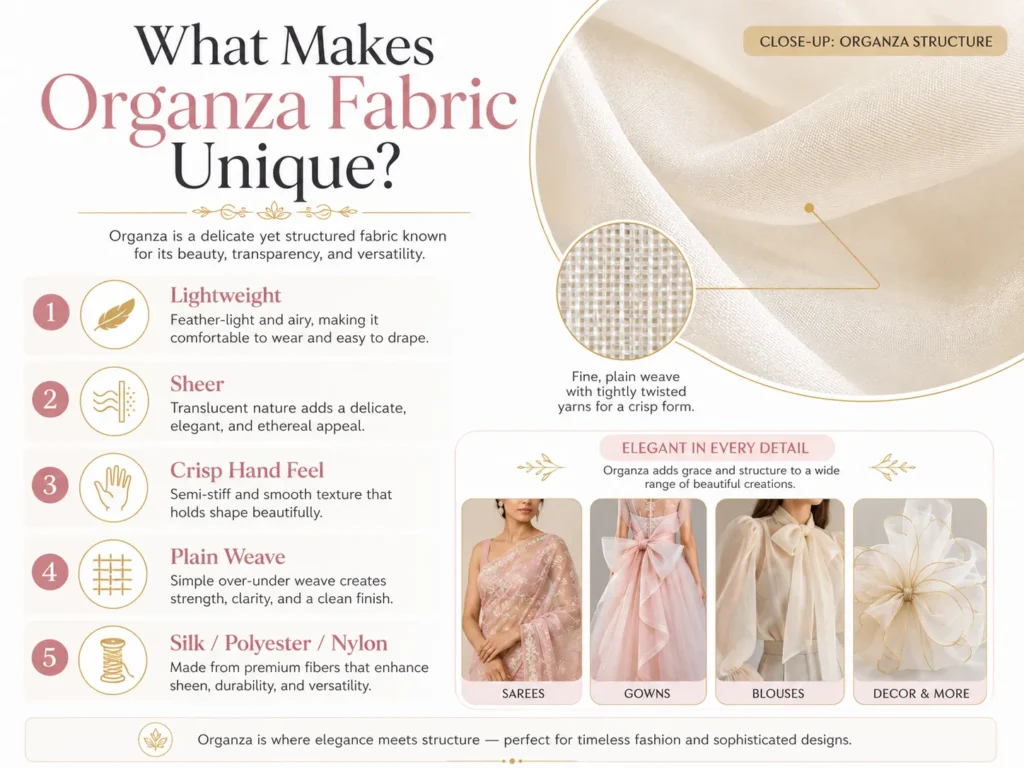
Organza has several characteristics that make it different from other sheer fabrics.
Sheer and Transparent
Organza is known for its transparent appearance. You can use it as an overlay, sleeve fabric, decorative panel, outer layer, or layering material.
This transparency helps you create depth without adding too much visual weight.
Lightweight
Organza is light. It can add volume without making the garment too heavy. This is why it is often used in wedding dresses, evening gowns, ruffles, and decorative layers.
If you need a fabric that looks full but still feels airy, organza is a strong option.
Crisp Hand Feel
Organza is usually crisp rather than soft. It has a slightly stiff hand feel, which helps it hold shape.
This crispness is useful for puff sleeves, structured skirts, bows, decorative overlays, and garments that need a light but visible form.
Subtle Shine
Many organza fabrics have a slight shine. The shine is usually more delicate than satin. It gives the fabric a refined, elegant look without making it too heavy or glossy.
Good Shape and Volume
Organza can create volume and structure. It is often used when you want a skirt to stand out, a sleeve to hold shape, or a decorative layer to look more three-dimensional.
Compared with chiffon, organza is usually stiffer. Compared with tulle, organza usually has a more fabric-like surface.
Delicate but Structured
Organza looks delicate, but it can provide structure. That is one reason designers like it.
However, it is still a fine fabric. It can snag, fray, crease, or be damaged by rough handling. You need to consider sewing, packaging, and care before using it in production.
Different Types of Organza Fabric
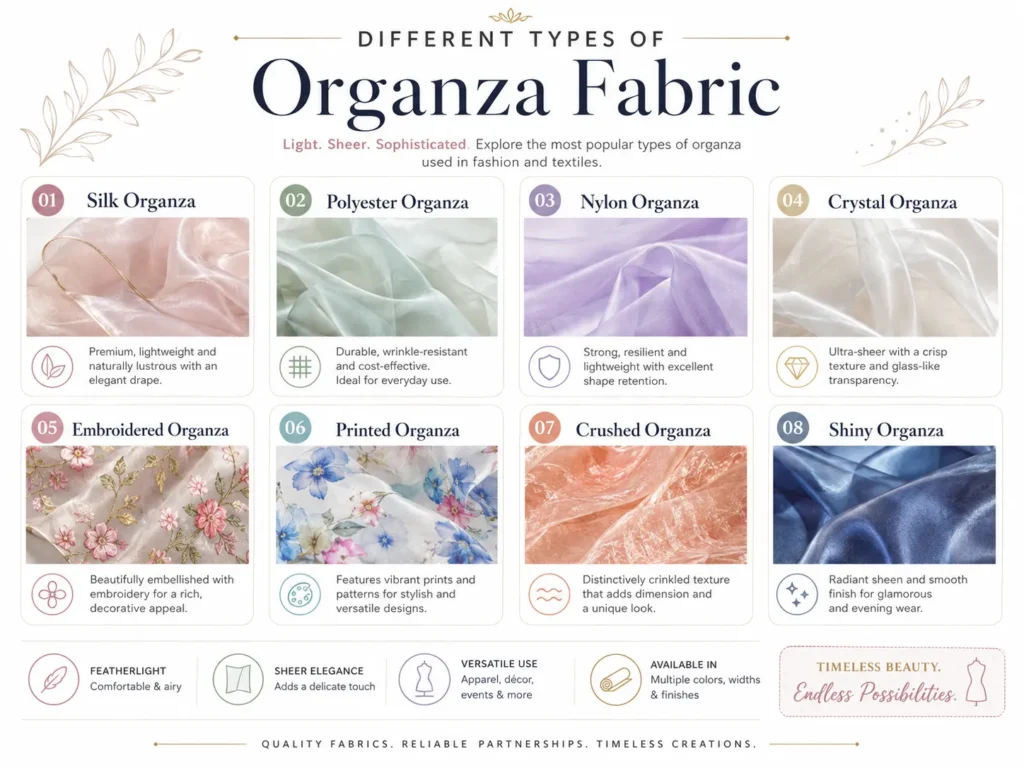
There are many types of organza fabric. Each one has a different look, cost, and application.
Silk Organza
Silk organza is elegant, refined, and premium. You may choose it for luxury bridalwear, couture gowns, high-end evening dresses, and premium fashion projects.
It has a natural fiber story and a more luxurious feel, but it is also more expensive and requires more careful care.
Polyester Organza
Polyester organza is widely used in commercial production. It is cost-friendly, available in many colors, and suitable for bulk orders.
You may choose it for bridalwear, stage costumes, decorations, packaging, and commercial fashion products.
Nylon Organza
Nylon organza is lightweight and can have a different feel from polyester organza. It may be used in trims, accessories, packaging, and special design projects.
Crystal Organza
Crystal organza has a shinier, brighter surface. It is often used for evening dresses, partywear, stage costumes, and decorative applications.
If you want stronger visual impact under lights, crystal organza may be useful.
Embroidered Organza
Embroidered organza uses organza as the base fabric and adds embroidery on top. It is common in bridalwear, evening gowns, sleeves, decorative panels, and fashion overlays.
When sourcing embroidered organza, you need to check embroidery density, thread quality, base fabric strength, and pattern stability.
Printed Organza
Printed organza has printed patterns on a sheer base. It can be used for fashion garments, children’s wear, decorations, and seasonal collections.
You should check print clarity, color fastness, color matching, and bulk print consistency.
Crushed Organza
Crushed organza has a textured, wrinkled, or crinkled surface. It gives a more dimensional visual effect and is often used for special design, stagewear, and decorative products.
Mirror Organza or Shiny Organza
Mirror organza or shiny organza has a stronger reflective effect. It is suitable for festive garments, stage costumes, party decoration, and products that need a more eye-catching surface.
What is Organza Fabric Used For?
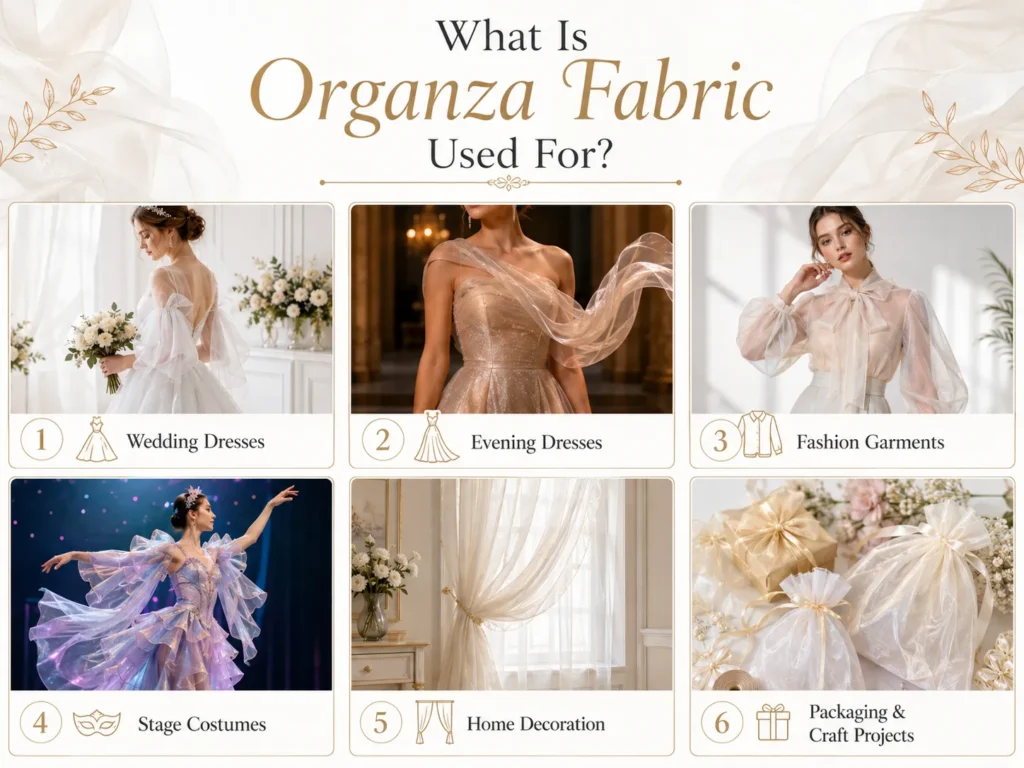
Organza is used in many fashion, decoration, and packaging applications.
Bridalwear and Wedding Dresses
Organza is widely used in wedding dresses because it adds volume, structure, and romance without too much weight.
You can use it for:
- Skirts
- Overlays
- Sleeves
- Veils
- Ruffles
- Bows
- Decorative layers
If you want a wedding dress to look airy but still hold shape, organza can be a very practical fabric choice.
Evening Dresses and Formalwear
Organza is often used in evening dresses, gowns, banquet dresses, and formalwear.
It works well for overlays, ruffles, decorative sleeves, transparent panels, and layered skirts. It helps create a premium look without relying only on heavy fabrics.
Fashion Garments
You can also use organza in fashion garments such as sheer blouses, statement sleeves, skirts, dresses, and layered tops.
It is especially useful when you want transparency, volume, and a modern design effect.
Stage Costumes and Performance Wear
Stage costumes often need visual impact. Organza performs well under lighting because it is sheer, lightweight, and slightly shiny.
You may use it for dance costumes, performance outfits, theatrical garments, and decorative costume layers.
Home Decoration
Organza can be used for curtains, table decoration, party decoration, floral wrapping, and event styling.It is useful when you need a light, transparent, decorative fabric.
Packaging and Craft Projects
Organza is also common in gift packaging and crafts. You may see it used for gift bags, sachet bags, wedding favors, luxury packaging, jewelry packaging, and handmade decorations.
Advantages of Organza Fabric
Elegant Visual Appearance
Organza looks light, transparent, and refined. It can create a luxury feeling without adding too much weight.
This makes it suitable for bridal, eveningwear, decoration, and premium packaging.
Adds Volume Without Heavy Weight
Organza can build shape and volume while staying lightweight. This is valuable for wedding dresses, layered skirts, ruffles, and decorative forms.
Works Well for Layering
Organza works well with satin, lining, lace, tulle, chiffon, and other fabrics.
You can use it as an outer layer, overlay, sleeve fabric, or decorative structure.
Available in Many Colors and Finishes
Polyester organza and nylon organza are available in many colors and finishes. You can find printed, embroidered, crushed, shiny, crystal, and customized options.
For commercial brands, this flexibility helps product development.
Disadvantages of Organza Fabric
It Can Be Easily Snagged
Organza is delicate. It may snag if it touches sharp objects, rough surfaces, or poor-quality packaging.
If you are producing garments or accessories with organza, you need to protect the fabric during cutting, sewing, packing, and shipping.
It Has Limited Stretch
Organza is a woven fabric, so it usually has little to no natural stretch.
If your product needs high elasticity, close body movement, or activewear performance, organza should not be your main stretch fabric.
It Can Feel Stiff Against the Skin
Organza is crisp and structured. That is part of its value. But if it is used directly against the skin, it may feel less comfortable than chiffon, jersey, satin, or other softer fabrics.
That is why organza is often used as an outer layer, decorative layer, or structural layer rather than a full lining or skin-contact fabric.
It Needs Proper Edge Finishing
Organza can fray at the edges. You may need rolled hems, binding, overlocking, French seams, or other finishing methods.
For bridalwear and eveningwear, edge finishing can strongly affect the final quality.
How Does Organza Fabric Impact the Environment?
The environmental impact of organza fabric depends mainly on fiber type, production process, dyeing, finishing, product lifespan, and end use.
You should not say all organza is sustainable or all organza is harmful. You need to look at what it is made of and how it is produced.
Silk Organza and Environmental Considerations
Silk organza is made from natural silk fiber. Silk is biodegradable under suitable conditions, but silk production still has environmental impacts.
A 2025 life cycle study on raw silk production in China found that mulberry cultivation accounted for 46% of the total environmental impact of raw silk production. The study also identified urea, potassium chloride, electricity, steam, and silk reeling processes as important contributors.
This means silk organza may have a natural fiber advantage, but it still requires responsible sourcing, farming, reeling, dyeing, and finishing.
Polyester and Nylon Organza Considerations
Polyester organza and nylon organza are synthetic. They are widely used because they are cost-effective, durable, colorful, and suitable for mass production.
However, synthetic textiles can contribute to microfiber pollution. Research published in Scientific Reports states that microplastic pollution from washing synthetic textiles has been assessed as a major source of primary microplastics in the oceans.
Another 2024 review in Pollution found that textile materials are one of the primary sources of microplastic pollution, and washing is the most significant way textile products release microplastic fibers.
For buyers, this does not mean you can never use polyester or nylon organza. It means you should consider product lifespan, washing frequency, quality, reuse potential, and whether lower-impact or recycled options are available.
How You Can Make Better Sourcing Decisions
If you want to source organza more responsibly, you can:
- Confirm fiber composition
- Ask for testing reports
- Consider recycled polyester options where suitable
- Avoid unnecessary overproduction
- Choose durable quality for longer product life
- Check dyeing and finishing standards
- Reduce single-use applications when possible
- Ask suppliers about certifications or traceability
- Choose the right fabric for the right product, not only the cheapest option
For B2B buyers, the best environmental decision is often practical: choose a fabric that performs correctly, lasts long enough for its intended use, and avoids unnecessary waste.
Organza Fabric vs Other Similar Fabrics
Organza is often compared with chiffon, tulle, satin, georgette, and tissue fabric. These fabrics may look similar in product photos, but they behave very differently.
Organza vs Chiffon
Organza is crisper and more structured. Chiffon is softer and more flowing.
Choose organza if you need volume, transparency, and shape. Choose chiffon if you need softness, movement, and a more fluid drape.
Organza vs Tulle
Tulle is a net fabric. Organza is a woven sheer fabric.
Tulle has a more open mesh look. Organza has a finer, smoother, more fabric-like surface. Both can be used in bridalwear, but they create different visual effects.
Organza vs Satin
Satin is smoother, heavier, shinier, and more opaque. Organza is lighter, sheer, and crisper.
Satin is often used as a main fabric or inner layer. Organza is often used as an outer layer, overlay, or decorative layer.
Organza vs Georgette
Georgette is softer, more flowing, and often has a slightly crinkled texture. Organza is stiffer, more transparent, and more structured.
Choose georgette if you want drape. Choose organza if you want shape.
Organza vs Tissue Fabric
Tissue fabric and organza are not exactly the same.
Tissue fabric usually refers to a very thin, shiny, often metallic-looking fabric. Organza refers more specifically to a sheer, crisp, woven fabric.
In some markets, shiny organza or metallic organza may be described similarly to tissue fabric, but you should always check the fiber, weave, finishing, and hand feel before ordering.
How to Choose the Right Organza Fabric
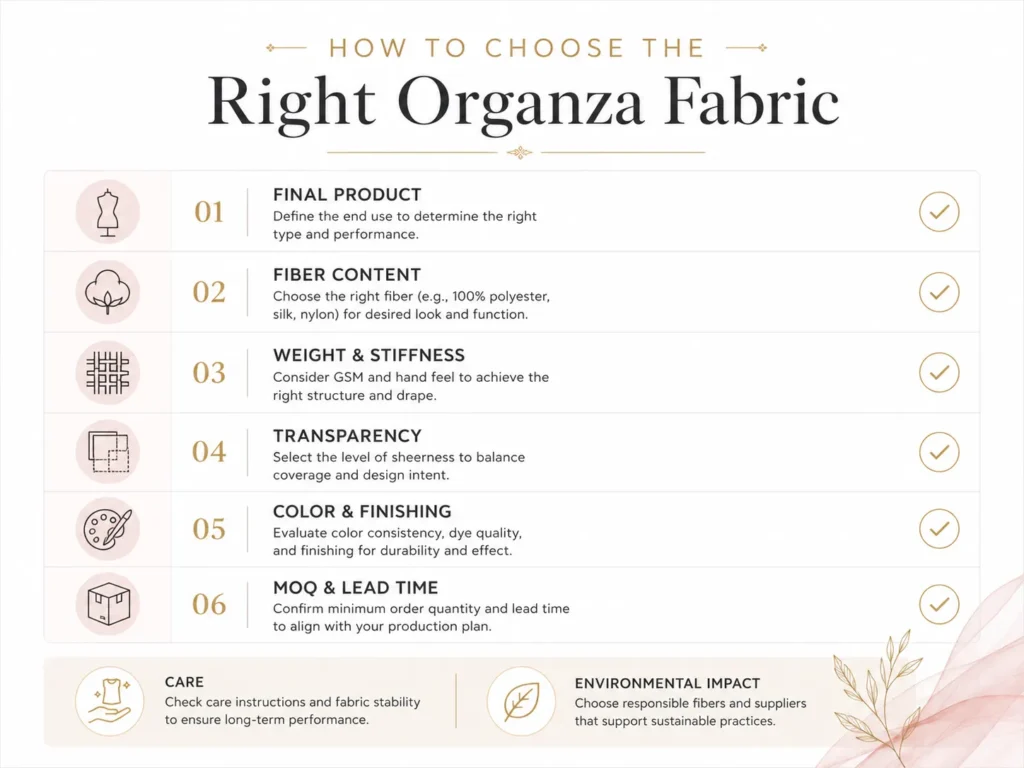
Before you choose organza, start with your final product. Do not begin with color only. Do not choose only by photo. Ask what the fabric needs to do.
Start with the Final Product
You should ask:
- Are you making a wedding dress, evening gown, blouse, sleeve, decoration, or packaging item?
- Do you need high transparency or only a light sheer effect?
- Do you need a soft feel or crisp structure?
- Will the fabric touch the skin directly?
- Will it be used as a main fabric, overlay, lining, or decoration?
- Do you need printing, embroidery, crushing, dyeing, or beading?
- Is the product for small-batch design or bulk production?
Your final product should guide your fabric choice.
Check Fiber Content
If you need premium quality, silk organza may be suitable. If you need commercial bulk production, polyester organza may be more practical. If you need a lightweight synthetic option, nylon organza may work.
Never assume all organza is the same. Always confirm fiber composition.
Check Weight and Stiffness
Different organza fabrics have different weights and stiffness levels.
For bridal skirts, you may need a stiffer organza. For sleeves or blouses, you may need a lighter and softer version. For packaging, you may focus more on cost, color, and shape.
Check Transparency
Transparency affects the final look. A fabric may look good as a single layer but change completely when layered over satin, lining, lace, or skin-tone fabric.
Always test organza on the actual base fabric or garment design.
Check Color and Finishing
Organza can look different under different lighting. White, ivory, champagne, nude, and pastel colors can be especially sensitive.
Before bulk production, you should confirm lab dips, color matching, color fastness, and finishing effect.
Check MOQ and Lead Time
Standard colors may be available faster. Custom colors, embroidery, printing, crushing, or special finishing may require longer lead time and higher MOQ.
If your production timeline is tight, confirm sample time, bulk lead time, and shipping time early.
How to Care for Organza Fabric
Organza care depends on fiber type and garment construction.
Washing and Cleaning
Silk organza usually needs more delicate care. Dry cleaning or gentle hand washing may be recommended depending on the garment.
Polyester organza is generally easier to maintain, but delicate garments, embroidery, and structured dresses still need careful handling.
You should always follow the garment care label. If you are developing a product for sale, test the care method before finalizing production.
Ironing and Steaming
You can iron organza, but you need to be careful.
Use low heat, press from the reverse side if possible, and place a pressing cloth between the iron and the fabric. Test on a small area first.
High heat can damage shine, change stiffness, or deform the fabric, especially with synthetic organza.
Storage Tips
To store organza properly, you should:
- Avoid heavy pressure
- Keep it away from sharp objects
- Store it in a dry environment
- Avoid long exposure to strong sunlight
- Protect it during shipping
- Hang or professionally pack bridal and evening garments
Because organza can snag or crease, storage and packaging are important for maintaining product quality.
Common Mistakes When Buying Organza Fabric
Only Looking at Transparency
Transparency is important, but it is not the only factor. You also need to check stiffness, yarn quality, density, hand feel, and how the fabric performs in the final product.
Ignoring Fiber Composition
Silk organza and polyester organza are very different in price, care, hand feel, and positioning.
If you do not confirm fiber content, you may choose the wrong fabric for your market.
Choosing the Wrong Stiffness
If the organza is too soft, it may not support the silhouette. If it is too stiff, it may feel uncomfortable or look too rigid.
You need to match stiffness to product use.
Not Testing the Fabric Before Bulk Order
Photos cannot show everything. Organza can look different under different light, over different linings, and in different layers.
Always test samples before bulk production.
Ignoring Sewing and Edge Finishing
Organza can fray and needs proper finishing. Poor seams, rough edges, or bad hemming can make the final product look cheap.
For bridalwear and eveningwear, finishing quality is especially important.
Ignoring Environmental Requirements
If your target customers care about sustainability, you need to ask about fiber origin, certifications, recycled options, dyeing process, and supplier traceability.
Environmental requirements can affect buyer decisions, especially for overseas fashion brands.
Conclusion: Is Organza Fabric Right for Your Project?
Organza fabric is a lightweight, sheer, crisp woven fabric that works well when your product needs transparency, structure, volume, and elegance. It is commonly used in wedding dresses, evening gowns, fashion garments, stage costumes, decoration, packaging, and craft projects.
However, you should not choose organza only because it looks beautiful in a photo. You need to check the fiber content, weight, stiffness, transparency, color, finishing, MOQ, lead time, care method, and environmental requirements.
If you need a luxury natural option, silk organza may be suitable. If you need a more commercial and cost-effective option, polyester organza may be more practical. If you need special visual effects, you may consider crystal, embroidered, printed, crushed, or shiny organza.
The best organza fabric is not simply the most beautiful one. It is the one that performs correctly in your final product, fits your production needs, and supports the quality your customer expects.
FAQ About Organza Fabric
How does organza fabric impact the environment?
The environmental impact depends on the fiber type. Silk organza comes from natural silk but still involves farming, reeling, dyeing, and finishing impacts. Polyester and nylon organza are synthetic and may contribute to microfiber pollution, especially during washing.
How to clean organza fabric?
You should clean organza according to fiber content and garment construction. Silk organza often needs dry cleaning or gentle hand washing. Polyester organza is usually easier to care for, but delicate garments should still be handled carefully.
Can you iron organza fabric?
Yes, but use low heat, a pressing cloth, and test a small area first. High heat can damage organza, especially synthetic organza.
Can you dye organza fabric?
Yes, organza can be dyed, but the dyeing method depends on the fiber. Silk, polyester, and nylon need different dyes and processes. For B2B custom color orders, you should request lab dips before bulk production.
How much is organza fabric?
The price depends on fiber content, weight, width, finishing, color, MOQ, and order quantity. Silk organza is usually more expensive, while polyester organza is more suitable for commercial bulk orders.
Is organza a good fabric?
Yes, organza is a good fabric if your product needs transparency, light structure, volume, and elegance. It is not ideal for high-stretch garments or very soft skin-contact products.
Is organza a natural fabric?
Not always. Silk organza is natural. Polyester organza and nylon organza are synthetic. You need to check fiber composition before buying.
Is organza a summer fabric?
Organza can work well in summer designs because it is lightweight and sheer. However, it is usually crisp rather than soft, so it is often better as an outer layer, sleeve, overlay, or decorative part instead of a full skin-contact fabric.
Is organza fabric soft?
Organza is usually not very soft. It is more crisp, slightly stiff, and structured. If you need a softer sheer fabric, chiffon or georgette may be better.
What fabric is similar to organza?
Similar fabrics include chiffon, tulle, voile, organdy, georgette, and some sheer polyester fabrics. However, each one has different transparency, stiffness, drape, and structure.
Is tissue and organza fabric same?
No, tissue fabric and organza fabric are not exactly the same. Tissue fabric often has a shiny or metallic effect, while organza is known for its sheer, crisp woven structure. Some shiny organza may look similar to tissue fabric, so you should confirm the exact material and finish.
Is organza fabric see-through?
Yes. Organza is known for its sheer and transparent appearance.
Is organza fabric stretchy?
No. Organza is a woven fabric and usually has little to no stretch.
What is the difference between organza and chiffon?
Organza is crisper and more structured. Chiffon is softer and more flowing.
Can organza fabric be printed or embroidered?
Yes. Organza can be printed, embroidered, crushed, beaded, or finished in different ways, depending on the base fabric, design, MOQ, and production process.