
For apparel brands, designers, and fabric buyers, choosing between knit fabric and woven fabric is not only a technical decision. It affects fit, comfort, durability, sewing, cost, performance, and even how customers feel when they wear the final garment.
In this guide, you will learn the key differences between knit vs woven fabric and how to choose the right material based on your apparel project.
What Is Knit Fabric?
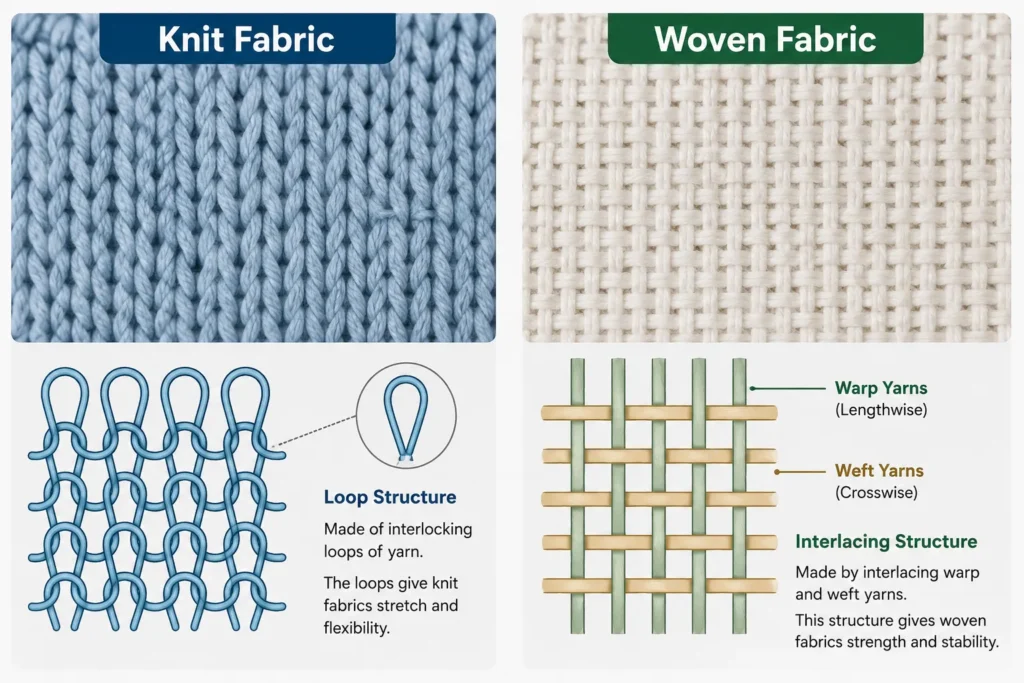
Knit fabric is made by interlocking yarn loops. Instead of using a traditional warp and weft structure, knit fabric is created through looped yarns that connect with each other.
Because of this loop structure, knit fabric usually has more stretch and flexibility than woven fabric. Even when there is no spandex, many knit fabrics still have a degree of natural stretch.
Knit fabric is often chosen when a garment needs softness, comfort, movement, and a closer fit to the body. This is why you commonly see knit fabric used in T-shirts, underwear, babywear, activewear, leggings, hoodies, sweatshirts, loungewear, and pajamas.
Common Features of Knit Fabric:
- Soft hand feel
- Better stretch
- Flexible structure
- Comfortable wear
- Good body movement
- Natural drape
- Closer fit to the body
Common Types of Knit Fabric:
- Single jersey
- Rib knit
- Interlock fabric
- French terry
- Fleece
- Ponte knit
- Scuba knit
- Mesh knit
- Cotton spandex jersey
- Polyester spandex knit
For example, single jersey is widely used for T-shirts and basic tops. Rib knit is often used for cuffs, necklines, tank tops, and fitted garments. French terry is common for hoodies and sweatshirts. Fleece is often used for winter wear and loungewear. Spandex knit fabrics are frequently used for activewear, leggings, and sportswear.
However, knit fabric also requires careful control. Before bulk production, you need to check shrinkage, pilling, GSM, stretch percentage, recovery rate, and washing performance.
A knit fabric may feel good in the sample stage, but if it loses recovery after wear or shrinks heavily after washing, the final garment may not meet customer expectations.
What Is Woven Fabric?
Woven fabric is made by interlacing two sets of yarns: warp yarns and weft yarns. These yarns cross each other at right angles to create a stable fabric structure.
Compared with knit fabric, woven fabric usually has less natural stretch, unless spandex or elastane is added. But its advantage is structure. Woven fabric can hold shape better, support cleaner silhouettes, and provide a more stable foundation for tailored garments.
Common Features of Woven Fabric:
- Stable structure
- Better shape retention
- More formal appearance
- Cleaner silhouette
- Good dimensional stability
- Stronger support for structured garments
- Better suitability for cutting and tailoring
This is why woven fabric is often used for shirts, pants, jackets, dresses, uniforms, workwear, outerwear, and formal clothing.
Common Types of Woven Fabric:
- Poplin
- Twill
- Canvas
- Denim
- Chiffon
- Organza
- Satin
- Taffeta
- Oxford Fabric
- Woven Cotton Fabric
- Woven Tencel Fabric
- Polyester Woven Fabric
Poplin is often used for shirts and uniforms. Twill is common in pants, workwear, and jackets. Denim is traditionally used for jeans and casualwear. Chiffon works well for dresses and blouses. Organza is used in formalwear and decorative garments. Satin is commonly used for eveningwear, linings, and fashion dresses. Canvas is suitable for bags, utility products, and certain outerwear styles.
The biggest advantage of woven fabric is stability. It is often better for products that need a clear shape, crisp appearance, and stronger construction. But woven fabric also needs proper evaluation. You should check fiber content, weave type, density, fabric weight, shrinkage, tear strength, abrasion resistance, color fastness, finishing, width, MOQ, lead time, and bulk consistency.
Woven vs Knit Fabric: Key Differences
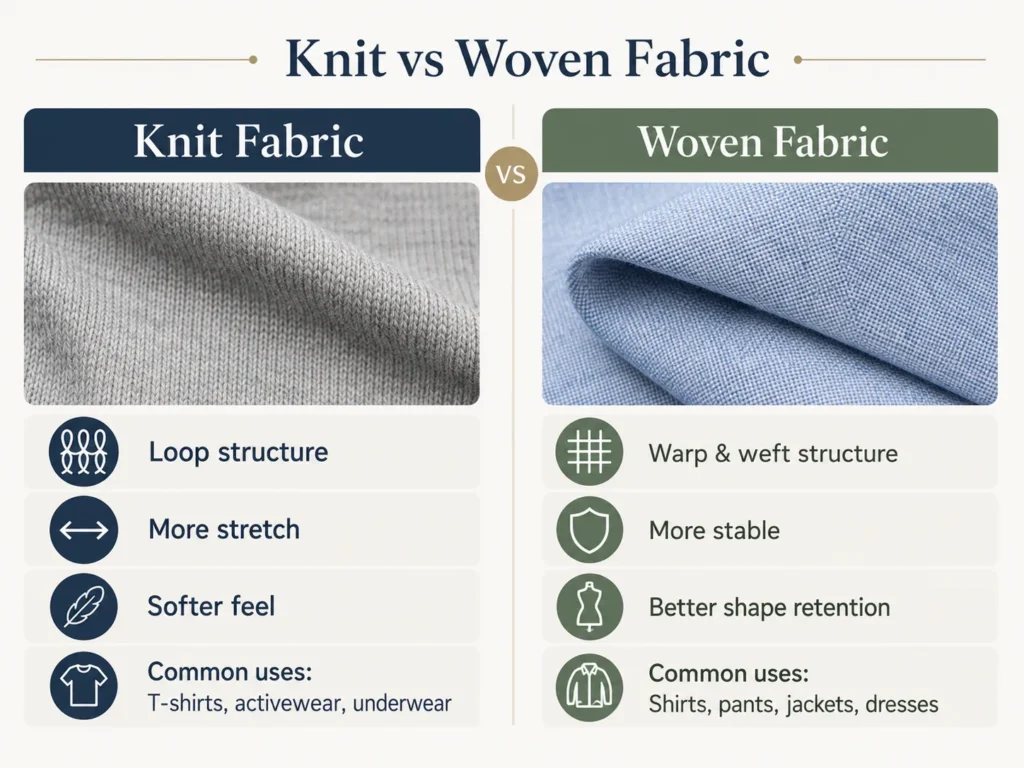
The difference between knit and woven fabric starts with structure. Knit fabric is made from loops. Woven fabric is made from interlaced warp and weft yarns. This difference affects almost everything: stretch, comfort, drape, durability, sewing process, and final garment use.
Fabric Structure
Knit fabric has a loop structure. The loops allow the fabric to stretch, bend, and move more easily. This makes knit fabric suitable for products that need flexibility and comfort.
Woven fabric has a warp-and-weft interlacing structure. This makes the fabric more stable and less likely to stretch out of shape. It is usually better for garments that need a clean outline and firm structure.
If your product needs movement, softness, and body comfort, knit fabric is often the better choice. If your product needs structure, tailoring, and shape retention, woven fabric is usually more suitable.
Stretch and Flexibility
Knit fabric usually has better natural stretch. When spandex or elastane is added, the stretch becomes stronger and more suitable for activewear, leggings, fitted tops, and sportswear.
Woven fabric usually has limited stretch. If you need flexibility in woven garments, you can choose stretch woven fabric, such as cotton spandex woven, polyester spandex woven, nylon spandex woven, stretch twill, or stretch poplin.
This is important for apparel buyers because stretch affects both fit and comfort. If a garment needs body movement but the fabric cannot stretch, the final product may feel restrictive. If a garment needs structure but the fabric is too stretchy, the final shape may look loose.
Hand Feel and Comfort
Knit fabric usually feels softer and more flexible against the skin. It is commonly used for T-shirts, underwear, children’s wear, loungewear, and sportswear because comfort is a key part of the wearing experience.
Woven fabric can feel light, crisp, smooth, firm, or structured depending on yarn, weave, and finishing. It is not always less comfortable than knit fabric, but it usually gives a more structured hand feel.
Comfort is not only about fiber content. A cotton knit and a cotton woven can feel completely different because their construction is different. The yarn count, finishing, GSM, density, and washing treatment also affect hand feel.
Drape and Shape
Knit fabric usually has a softer drape and follows the body more naturally. This works well for relaxed tops, body-hugging garments, stretch dresses, and athleisure pieces.
But if the knit fabric has poor recovery or is too lightweight for the design, the garment may look loose, unstable, or stretched out after wear.
Woven fabric usually holds shape better. It is more suitable for shirts, jackets, trousers, uniforms, structured dresses, and outerwear. If your design needs a clean collar, sharp placket, firm pocket, or tailored seam line, woven fabric may be more appropriate.
Durability and Shape Retention
Both knit and woven fabrics can be durable, but they have different risk points.
Knit fabric is comfortable and flexible, but some knit fabrics may stretch out, shrink, pill, or lose recovery if quality is not controlled. For knit fabric sourcing, you should pay attention to stretch recovery, shrinkage, pilling resistance, GSM stability, and washing performance.
Woven fabric usually has better dimensional stability and shape retention. It is often preferred for workwear, pants, jackets, shirts, uniforms, and products that need stronger structure. However, woven fabric can still have issues such as tearing, fraying, color fading, and poor abrasion resistance if the material is not properly tested.
Before bulk production, do not only rely on sample hand feel. You should confirm test data and bulk consistency.
Breathability and Warmth
Knit fabric can be breathable, especially in lightweight jersey or mesh structures. At the same time, fleece and French terry can provide warmth, making them useful for hoodies, sweatshirts, winter loungewear, and casual outer layers.
Woven fabric breathability depends on fiber, density, and weave type. Lightweight poplin, chiffon, and certain cotton woven fabrics can be breathable and suitable for shirts or summer dresses. Heavier twill, canvas, and denim are more durable and protective, but may feel less airy.
This means you should not judge breathability only by whether the fabric is knit or woven. You need to evaluate construction, yarn, density, weight, and finishing.
Production and Sewing Requirements
Knit fabric requires sewing methods that can handle stretch. Common sewing processes may include overlock, coverstitch, and stretch-friendly seams. Pattern making also needs to consider fabric elasticity and recovery.
Woven fabric is usually easier to cut into stable shapes. It works well for collars, plackets, pockets, panels, cuffs, structured seams, and tailored details. However, woven fabric also requires attention to shrinkage, grainline, fabric direction, and seam strength.
For B2B fabric sourcing, sewing compatibility matters. A fabric can look good as yardage but still create problems during production if it does not match the garment construction.
Knit Fabric Is Best For Which Products?
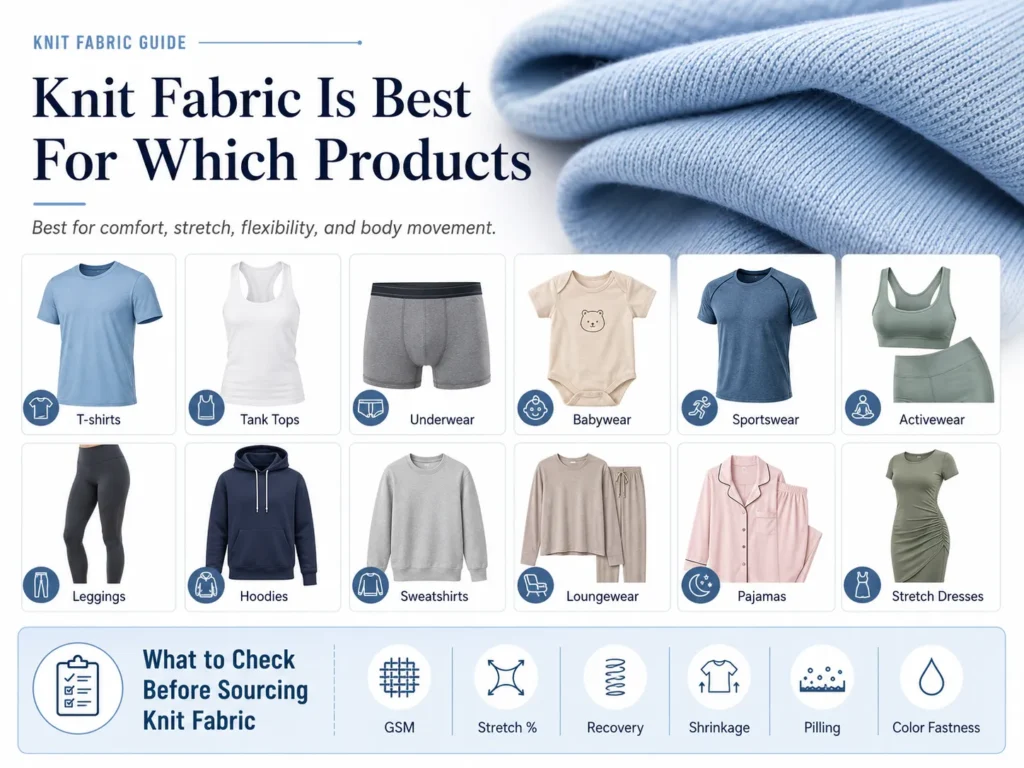
Knit fabric is usually suitable when your product needs comfort, stretch, flexibility, and body movement.
Common applications include:
- T-shirts
- Tank tops
- Underwear
- Babywear
- Sportswear
- Activewear
- Leggings
- Hoodies
- Sweatshirts
- Loungewear
- Pajamas
- Stretch dresses
- Casual tops
You should choose knit fabric if your product needs a soft touch, body-hugging fit, elastic movement, casual style, or comfortable daily wear.
Before sourcing knit fabric, check:
- Fabric weight / GSM
- Stretch percentage
- Recovery rate
- Shrinkage
- Pilling resistance
- Color fastness
- Hand feel after washing
- Spandex content
- Fabric width
- MOQ
- Bulk production consistency
The knitted fabric market was estimated at USD 23.8 billion in 2018 and projected to reach USD 35.7 billion by 2025, with a CAGR of 6.0% from 2019 to 2025, according to Grand View Research. The same report noted that weft-knit fabric accounted for more than 60% of the market by product in 2018.
This market growth reflects the wide use of knitted fabrics in apparel, technical textiles, household products, and performance-driven products.
Woven Fabric Is Best For Which Products?
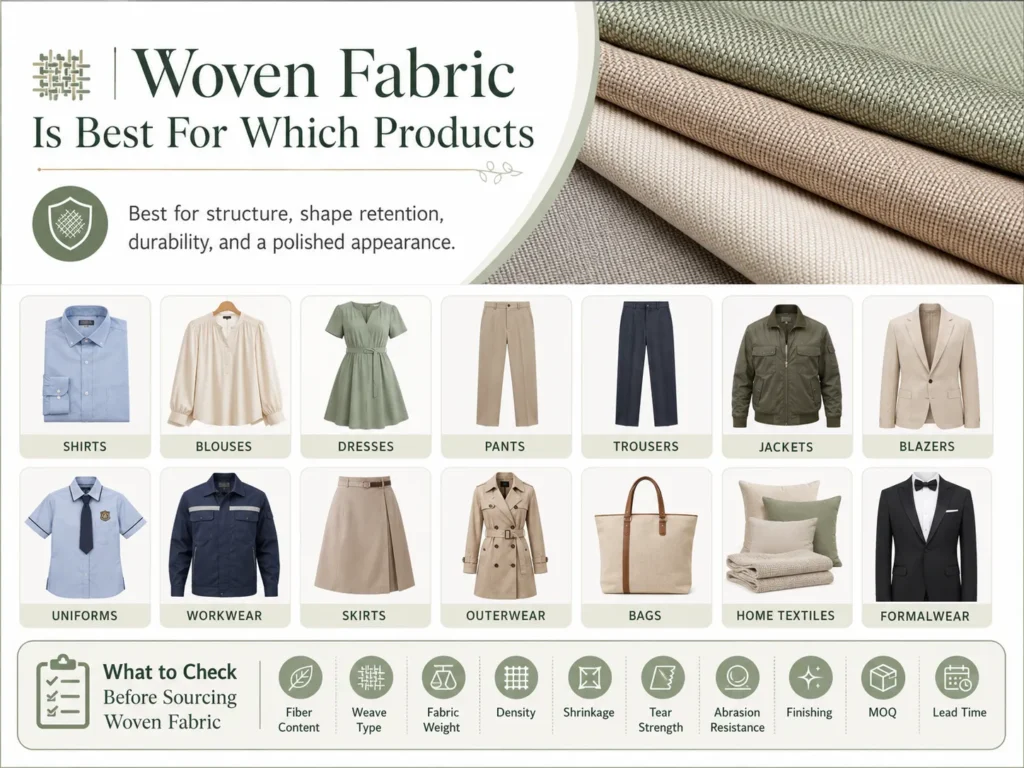
Woven fabric is usually suitable when your product needs structure, shape retention, durability, and a more polished appearance.
Common applications include:
- Shirts
- Blouses
- Dresses
- Pants
- Trousers
- Jackets
- Blazers
- Uniforms
- Workwear
- Skirts
- Outerwear
- Bags
- Home textiles
- Formalwear
You should choose woven fabric if your product needs a stable shape, clean silhouette, formal appearance, better dimensional stability, or stronger support for cutting and sewing.
Before sourcing woven fabric, check:
- Fiber content
- Weave type
- Fabric weight
- Fabric density
- Shrinkage
- Color fastness
- Tear strength
- Abrasion resistance
- Finishing
- Width
- MOQ
- Lead time
- Bulk consistency
For woven fabric, density and finishing can strongly change the final result. Two fabrics may both be called cotton twill, but their hand feel, strength, thickness, shrinkage, and garment performance can be very different.
How to Choose Between Knit and Woven Fabric
The best way to choose between knit and woven fabric is to start from the final product.
Do not ask, “Which fabric is better?”
Ask, “What does my garment need to do?”
Before choosing a fabric, consider:
- What type of garment are you making?
- Is it close-fitting or loose-fitting?
- Is it for sportswear, casualwear, workwear, or formalwear?
- Does the garment need stretch?
- Does it need to hold shape?
- Will it be washed frequently?
- Does it need to feel soft against the skin?
- Does it need a structured silhouette?
- Is it for lightweight summer wear or warmer autumn/winter wear?
Choose knit fabric if you need comfort, stretch, movement, and softness. This usually applies to yoga leggings, gym tops, T-shirts, babywear, underwear, lounge sets, hoodies, and stretch dresses.
Choose woven fabric if you need structure, shape retention, durability, and a cleaner appearance. This usually applies to shirts, pants, jackets, blazers, uniforms, dresses, workwear, and outerwear.
You can also consider stretch woven fabric if you want the structure of woven fabric but still need mobility. Stretch twill, stretch poplin, cotton spandex woven, polyester spandex woven, and nylon spandex woven are common choices for slim-fit pants, stretch shirts, outdoor apparel, uniforms, and workwear with movement.
Common Mistakes When Choosing Knit vs Woven Fabric
Choosing Only by Appearance
Some fabrics look similar in photos, but their structures are completely different. A buyer should not choose fabric only by color, print, or surface texture. Always confirm whether it is knit or woven.
Ignoring Stretch Requirements
If you make activewear with non-stretch woven fabric, the garment may feel restrictive. If you make a structured shirt with a soft knit fabric, the garment may lose its shape.
Not Checking Shrinkage
Shrinkage is especially important for cotton knit fabric and many natural fiber fabrics. Before bulk production, ask for wash test results and dimensional stability data.
Only Comparing Price
Lower-cost fabric may create higher hidden costs later, including unstable GSM, poor stretch recovery, pilling, color difference, hand feel changes, and bulk inconsistency.
Not Testing Bulk Fabric Before Production
A good sample does not always guarantee stable bulk production. Before placing a large order, confirm lab dips, sample yardage, testing results, and bulk production consistency.
Knit vs Woven Fabric Comparison Table
| Comparison Point | Knit Fabric | Woven Fabric |
| Structure | Loop structure | Warp and weft interlacing |
| Stretch | Usually more stretch | Usually less stretch |
| Comfort | Softer and more flexible | More structured |
| Shape | More body-hugging | Better shape retention |
| Common Uses | T-shirts, activewear, underwear | Shirts, pants, jackets, dresses |
| Sewing | Needs stretch-friendly sewing | Easier to hold shape |
| Drape | Softer drape | Cleaner structure |
| Stability | May stretch or deform | More dimensionally stable |
| Best For | Comfort and flexibility | Structure and durability |
Questions to Ask Your Fabric Supplier Before Ordering
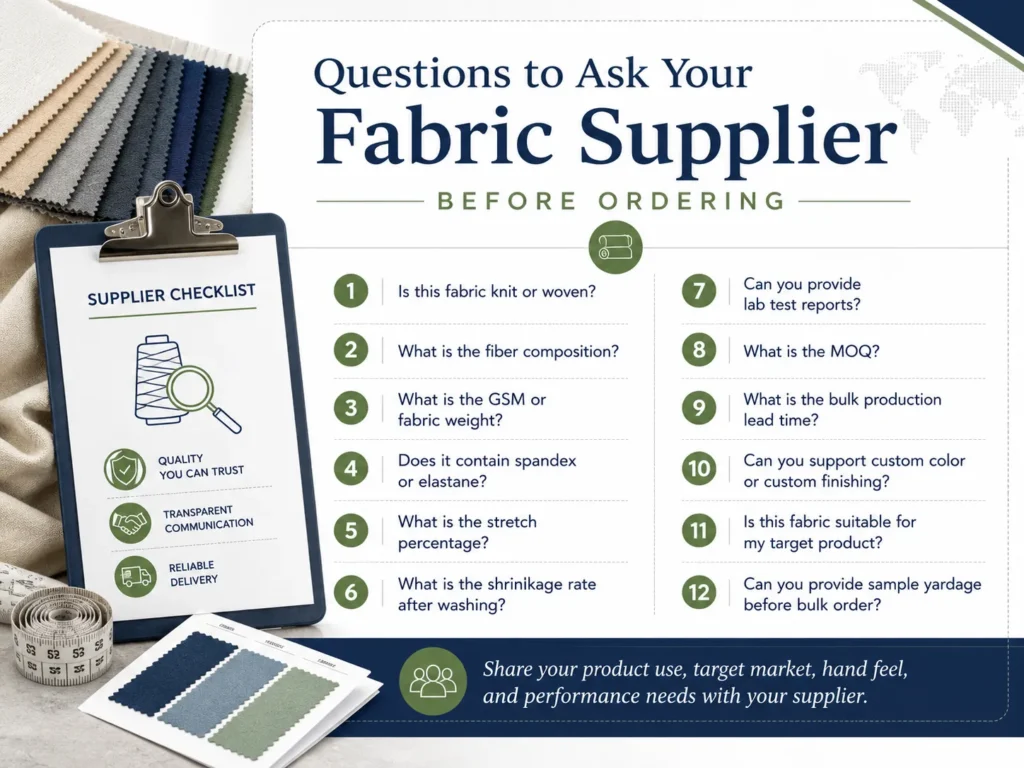
If you are sourcing fabric for apparel production, do not only ask for price. A better supplier conversation should include product use, target market, hand feel, performance needs, and production requirements.
Ask your supplier:
- Is this fabric knit or woven?
- What is the fiber composition?
- What is the GSM or fabric weight?
- Does it contain spandex or elastane?
- What is the stretch percentage?
- What is the shrinkage rate after washing?
- Can you provide lab test reports?
- What is the MOQ?
- What is the bulk production lead time?
- Can you support custom color or custom finishing?
- Is this fabric suitable for my target product?
- Can you provide sample yardage before bulk order?
A professional fabric supplier should not simply send the cheapest option. They should help you match the material to your garment type, target customer, washing requirement, sewing process, and bulk production needs.
At mufabric, we help apparel brands and fabric buyers source both knit fabric and woven fabric based on product use, fabric performance, customization needs, and bulk production requirements.
Conclusion: Choose the Fabric Based on the Product, Not Just the Name
The biggest difference between knit vs woven fabric comes from structure. Knit fabric is built with loops, which usually makes it softer, stretchier, and more flexible. Woven fabric is built with interlaced warp and weft yarns, which usually makes it more stable, structured, and suitable for shape retention.
For apparel brands and buyers, the right material is not simply the one that looks best in a sample photo or feels cheapest per yard. The right material is the one that matches your product purpose, wearing scenario, fit, washing performance, sewing process, and bulk production requirements.
If your garment needs softness, stretch, and body movement, knit fabric may be the better option. If your garment needs structure, clean tailoring, durability, and dimensional stability, woven fabric may be the better choice. And if your design needs both structure and movement, stretch woven fabric can be a practical middle path.
FAQ About Knit vs Woven Fabric
Is knit fabric better than woven fabric?
No fabric type is always better. Knit fabric is better for comfort, stretch, and flexibility. Woven fabric is better for structure, shape retention, and tailored garments.
How can I tell if a fabric is knit or woven?
Knit fabric usually has a loop structure and more stretch. Woven fabric usually has visible warp and weft yarns and a more stable structure.
Is jersey fabric knit or woven?
Jersey fabric is a knit fabric. It is commonly used for T-shirts, tops, underwear, and casualwear.
Is denim knit or woven?
Traditional denim is a woven fabric, usually made with a twill weave. Some stretch denim contains spandex for extra comfort.
Which fabric is better for T-shirts?
T-shirts usually use knit fabric, especially single jersey, cotton jersey, cotton spandex jersey, or polyester jersey.
Which fabric is better for shirts?
Most structured shirts use woven fabric, such as poplin, Oxford, twill, or woven cotton fabric.
Can woven fabric stretch?
Yes. Traditional woven fabric has limited stretch, but woven fabric with spandex or elastane can become stretch woven fabric.
Can knit fabric be used for formal clothing?
Yes. Some dense knit fabrics, such as ponte knit or scuba knit, can be used for dresses, business casual garments, and structured styles. The final result depends on fabric weight, structure, and garment design.